
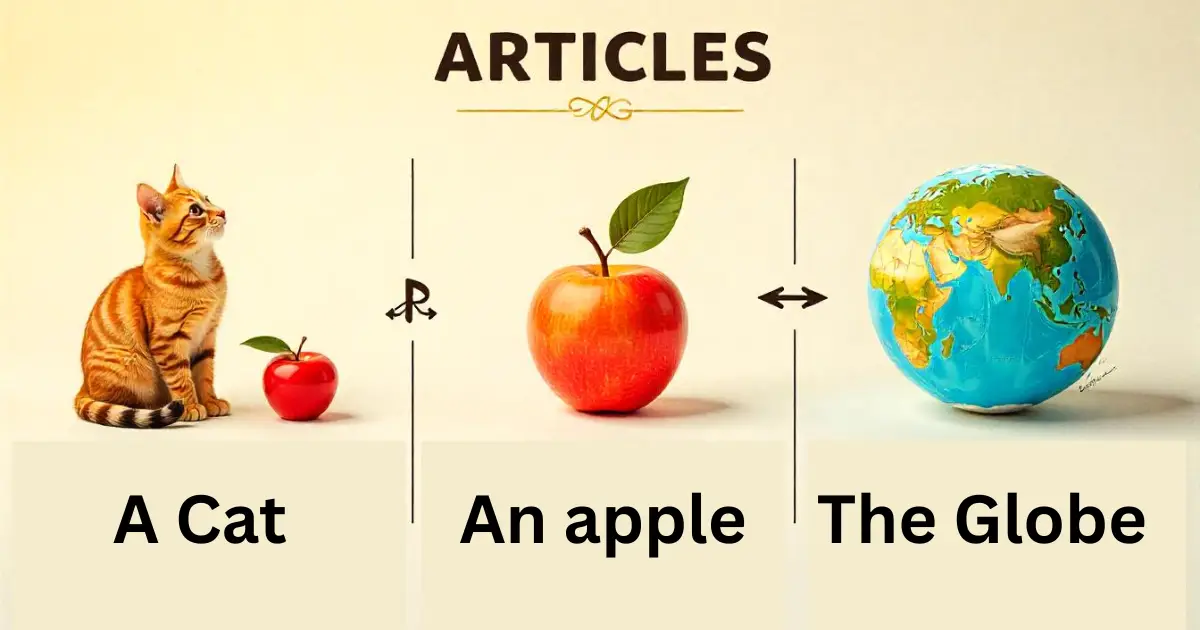

English learners often stumble when it comes to using articles like “a,” “an,” and “the.” Although they seem small, these words play a powerful role in defining and clarifying nouns.
Whether you’re a student, job seeker, or language enthusiast, mastering articles in English grammar is essential. In this article, we’ll break down the rules, non-usage scenarios, and exceptions related to articles in a way that’s simple and useful.
Read more – The Parrot’s Tale – Analysis, Symbolism, and Political Satire U1L1
What is an Article?
An article is a word that comes before a noun to define its definiteness or indefiniteness. Articles help us know whether we’re referring to something specific or something general.
In English, there are three articles:
- “A” – Indefinite article used before consonant sounds.
- “An” – Indefinite article used before vowel sounds.
- “The” – Definite article used before specific or previously mentioned nouns.
Articles are part of a broader category called determiners, which also includes this, that, some, many, etc. But articles are unique because they always come before a noun to determine whether it’s specific or general.
Why are “a,” “an,” and “the” called Articles?
The words “a,” “an,” and “the” are called articles because they are used to introduce nouns and give clarity about their reference.
- “A” and “An” are indefinite articles, meaning the noun they introduce is not specific.
- “The” is a definite article, meaning the noun it introduces is specific or known to the reader or listener.
Expanded Rules for Using Articles (“a”, “an”, “the”)
1. “A” and “An” – Indefinite Articles:
Used when referring to something for the first time, or when the exact identity is not important or unknown.
➤ General Rules:
- Use “a” before words that start with a consonant sound:
→ a dog, a hotel, a European country (note: “European” starts with a /j/ sound) - Use “an” before words that start with a vowel sound:
→ an actor, an egg, an MBA (note: “MBA” starts with an “em” sound)
➤ Special Use Cases:
- With professions:
→ She is an engineer. He is a teacher. - With certain numbers and units:
→ a dozen eggs, a hundred dollars - With exclamations:
→ What a beautiful painting! - With singular, countable nouns that are general:
→ I need a phone.
Read more – Khona: The Timeless Myth of Agricultural Wisdom – U3L4
2. “The” – Definite Article:
Used when referring to something specific, already mentioned, or known to the reader or listener.
➤ Use “The” when:
- Talking about something unique:
→ the sun, the moon, the sky - Referring to something already mentioned:
→ I saw a car. The car was red. - Referring to a specific person or thing:
→ Can you give me the book on the table? - With superlatives and ordinals:
→ the best student, the first time - With musical instruments:
→ She plays the piano. - With names of families or groups:
→ the Smiths, the British - With unique institutions or structures:
→ the Taj Mahal, the Eiffel Tower - With geographical features:
→ the Himalayas, the Nile, the Sahara - With hotels, cinemas, and organizations:
→ the Ritz Hotel, the UN, the Grand Cinema
Rules for Not Using Articles (Zero Article Usage):
1. With Proper Nouns:
- We don’t use articles before people’s names, cities, countries (exceptions exist, see below).
→ She visited India. I met Rahul.
2. Before Plural Nouns Used in General Sense:
→ Dogs are loyal.
→ Books are useful.
3. Before Uncountable Nouns Used in General:
→ Milk is good for health.
→ I love music.
4. Before Names of Meals:
→ We eat breakfast at 9.
(Note: “the” may be used when the meal is specific, e.g., The dinner at the wedding was excellent.)
5. Before Languages and Subjects:
→ She speaks French.
→ I like mathematics.
6. Before Games and Sport:
→ He plays football, not the football.
7. Before Modes of Transport (when preceded by “by”):
→ I go to school by bus.
→ She traveled by air.
Exceptions to Article Usage Rules:
English grammar is full of exceptions. Let’s break them down clearly.
Use “the” with Proper Nouns in Some Cases:
- Countries that include “Kingdom,” “Republic,” or “States”
→ the United Kingdom, the United States, the Czech Republic - Deserts, mountain ranges, oceans, and rivers
→ the Sahara, the Alps, the Atlantic, the Ganges - Historical buildings and monuments
→ the Taj Mahal, the Great Wall of China - Newspapers and organizations
→ the Times, the World Health Organization
Use “a/an” with Proper Nouns in Comparisons:
→ He’s a Mozart in music.
→ She’s an Einstein in science.
(This means the person resembles the famous figure in talent.)
Read more – Articles: ‘a’, ‘an’, ‘the’ | LearnEnglish
Exercise: Do yourself
Part 1: Fill in the Blanks (A/An/The) – [Basic Level] (1–20)
- I saw ___ elephant at the zoo.
- She wants to buy ___ orange.
- He is ___ honest man.
- I read ___ interesting book yesterday.
- They stayed at ___ hotel near the beach.
- I found ___ egg in the nest.
- ___ moon looks beautiful tonight.
- He is ___ European artist.
- She needs ___ hour to finish the task.
- Do you have ___ pen I can borrow?
- I saw ___ unicorn in the dream.
- We need to find ___ place to sit.
- They visited ___ Taj Mahal last summer.
- I watched ___ movie last night.
- He is ___ university professor.
- We took ___ umbrella because it was raining.
- She found ___ coin on the road.
- I would like to have ___ cup of tea.
- ___ Earth revolves around the Sun.
- He gave me ___ apple and ___ banana.
Part 2: Choose the Correct Article – [Multiple Choice] (21–30)
- He is ___ (a / an / the) doctor.
- She bought ___ (a / an / the) umbrella from the store.
- We went to ___ (a / an / the) Mount Everest last year.
- I have never seen ___ (a / an / the) owl before.
- My brother is reading ___ (a / an / the) interesting novel.
- She is ___ (a / an / the) only girl in the class.
- ___ (A / An / The) Nile is the longest river in the world.
- I need ___ (a / an / the) one-way ticket.
- I am watching ___ (a / an / the) TV show right now.
- He wants to be ___ (a / an / the) astronaut someday.
Part 3: Identify and Correct the Error (31–70)
(Each sentence has an error in article usage; identify and correct it)
- I saw a Eiffel Tower in Paris.
- She is the honest person.
- They visited the India last year.
- I went to an university.
- The sun rises from a east.
- I saw an one-eyed cat.
- We had a dinner at 8 p.m.
- She bought an European dress.
- We play the cricket every Sunday.
- The Mount Everest is the tallest mountain.
- He is an university student.
- We stayed in a inn near the beach.
- She’s reading the interesting novel you gave.
- The lions are dangerous animals.
- He drank a water after the run.
- A honesty is a rare virtue.
- The milk is good for bones.
- The John is my friend.
- I saw the owl in my backyard.
- She is a best dancer in school.
- An hour ago, a incident occurred.
- I met a old man who was very kind.
- We enjoyed the breakfast at her house.
- He is playing a violin in the concert.
- He left without the word.
- A iron is a useful metal.
- She took a umbrella with her.
- The Ganges is a sacred river in India.
- A elephant was walking in the forest.
- The Mount Fuji is located in Japan.
- We watched a eclipse last night.
- They are learning a English.
- She is reading a encyclopedia.
- The honesty is always respected.
- They found a unique solution.
- He is the engineer by profession.
- A sugar is not good for health.
- The Shakespeare is my favorite playwright.
- I want to be a astronaut.
- The apple she gave me was rotten.
Part 4: No Article Needed; Insert ✓ or ✗ (71–90):
(Write ✓ if the sentence is correct; ✗ if an article should be added or removed)
- Water is essential for life.
- She loves the music.
- He is good at mathematics.
- We play the football after school.
- She speaks Spanish fluently.
- I had the lunch at school.
- They visited Japan last summer.
- Lions are found in Africa.
- The love is a beautiful feeling.
- She goes to school by bus.
- We saw the Mount Everest.
- He studies the economics at university.
- The honesty is the best policy.
- They climbed Mount Kilimanjaro.
- He has experience in marketing.
- I watched television last night.
- She bought sugar from the market.
- The time is money.
- I went to hospital to see a friend.
- We learned grammar in class.
Part 5: Creative Sentence Formation (91–100)
Follow the instruction and write your own sentence.
- Write a sentence using “a” before a profession.
- Write a sentence using “an” before a noun starting with a vowel sound.
- Write a sentence using “the” before a unique object (like the sun, the moon).
- Write a sentence where “a” is used in an exclamation.
- Write a sentence using “an” before a silent ‘h’ word.
- Write a sentence using “the” before a superlative adjective.
- Write a sentence with no article before an uncountable noun.
- Write a sentence using “the” before a river, ocean, or mountain range.
- Write a sentence using “a” before a singular, countable noun.
- Write a sentence using “the” before a musical instrument.