


How to Make Passive Income with Digital Products is one of the most realistic ways to build leveraged online revenue because you are creating an asset once and then selling or licensing it repeatedly. The model works best when the product solves a clear problem, the delivery is automated, and the page itself is helpful enough to rank, convert, and earn referrals over time.
At its core, How to Make Passive Income with Digital Products means combining expertise with systems. The market conditions are favorable: Goldman Sachs projected the creator economy could approach $480 billion by 2027, Gumroad says it has paid over $1 billion to creators since launch, Teachable reported creators reached over 95 million lifetime students in 2025, Etsy reported 86.5 million active buyers in 2025, and Grand View Research estimated the global e-learning services market at $299.67 billion in 2024, projecting $842.64 billion by 2030. Those numbers matter because they show buyers are already comfortable paying for knowledge, downloads, and digital convenience.
This article shows you how to choose the right product, set up an evergreen sales system, and optimize the page for modern search visibility without sounding robotic. It also follows Google’s current people-first content guidance, which emphasizes originality, expertise, trust signals, clear headings, and a satisfying user experience over manipulative SEO tricks.
YouTube – 7 Steps to Monetize Your Channel 2026
Why digital products are ideal for passive income
Why this model compounds better than one-off work
- Delivery can be automated almost immediately. Shopify’s Digital Downloads app can automatically send download links after purchase, Etsy supports instant downloads and made-to-order downloads, and Amazon KDP distributes digital books globally with simple self-publishing workflows. That means the transaction can happen while you sleep, without manual shipping or fulfillment.
- The reason How to Make Passive Income with Digital Products keeps attracting creators is simple: one product can sell more than once without being rebuilt from scratch. A service business usually resets to zero every month, but a template, ebook, mini-course, or printable can keep earning as long as the offer stays useful and the page keeps attracting buyers. Platform features like automated delivery, paid newsletter subscriptions, and recurring access make that leverage stronger.
- Demand is already proven across multiple categories. Etsy actively promotes downloadable art, patterns, templates, and résumé templates; Shopify highlights ebooks, graphics, audio, and video files; KDP supports digital books; and creator platforms such as Kit and Substack support paid newsletters and other digital products. In other words, you do not need to invent a new market. You need to enter a real one with a sharper offer.
- SEO and owned audience can compound together. Google recommends people-first content that demonstrates first-hand experience, clear expertise, and original value. At the same time, creator tools such as Kit position email sequences and automations as systems that run continuously. When SEO brings the click and email captures the lead, the same product can generate sales from search, subscribers, and repeat campaigns.
- The big mindset shift is this: passive does not mean effortless. You still need research, positioning, proof, support, and occasional updates. Google explicitly asks whether content is original, complete, trustworthy, and satisfying. So, the most profitable “passive” product is usually the one you can improve over time without rebuilding the whole business.
What makes a digital product truly scalable
- It solves one painful problem clearly. “50 productivity templates for busy managers” is stronger than “digital resources for success.”
- It has instant or low-friction delivery. Buyers should receive access right after checkout.
- It is easy to preview. Samples, module lists, screenshots, and before-and-after examples lift conversions.
- It leads naturally to the next offer. A $19 template pack can lead to a $79 bundle, a $199 course, or a $15 monthly membership.
- It benefits from search intent. Products tied to repeat searches such as “resume template,” “budget planner,” “client onboarding checklist,” or “Canva social media kit” often have stronger evergreen discovery potential.
7 Real Steps for Facebook Monetization in 2026
Best digital products to create for passive income
The strongest product formats for beginners and growth-stage creators
- Templates and swipe files are usually the easiest entry point because they are fast to create, outcome-driven, and easy to demonstrate. Etsy specifically highlights downloadable templates and résumé templates, and template buyers are often already problem-aware. That makes this category excellent for first-time sellers.
- Printables, planners, and worksheets work well when the buyer wants immediate action. The best versions are not generic decorations. They are decision tools: meal planners, classroom systems, wedding timelines, budgeting sheets, or ADHD-friendly routines. Etsy’s instant-download model is especially aligned with this format.
- Ebooks and short guides are ideal when your edge is explanation, synthesis, or process. KDP lets authors self-publish digital books to Amazon stores around the world and earn up to 70% royalty on eligible ebooks, which makes ebooks a strong bridge between search-friendly education content and direct monetization.
- Mini-courses and workshop-based products are powerful when your process needs demonstration. If the user has to see the clicks, steps, or workflow, video usually justifies a higher price than a plain PDF. Teachable’s scale, with creators reaching over 95 million lifetime students by 2025, underscores the durability of course-based demand.
- Paid newsletters and memberships are excellent when your topic changes regularly and people want ongoing insight, not a one-time file. Kit markets paid newsletters, digital products, and automations designed to run continuously, while Substack emphasizes easy paid subscriptions. These are better for recurring revenue than for one-off download volume.
- Bundles and resource libraries often outperform standalone files because they increase average order value without requiring a new acquisition cost for every extra item. A customer deciding between one checklist and an entire toolkit often chooses the bundle when the positioning is specific enough.
The smartest way to choose your first offer
- Start with a problem you already solve repeatedly. If people keep asking you the same question in DMs, meetings, comments, or support emails, that is product fuel.
- Choose a product that shows transformation fast. Buyers love shorter paths to a result.
- Favor narrow over broad. A niche product for a clear buyer often outranks and outsells a vague “everything bundle.”
- Pick the lowest-maintenance version first. A template pack is often easier to support than a full course.
- Build around proof you already own. If you have screenshots, outcomes, teaching clips, or client wins, your sales page becomes dramatically easier to write.
Build your evergreen sales machine
To understand How to Make Passive Income with Digital Products, think in systems rather than launches. A solid digital-product business is usually a chain: traffic, lead capture, product page, checkout, delivery, follow-up, review request, and upsell. When each step is clear, the business becomes more passive with every iteration.
A practical system that works
- Choose one buyer and one promise. Write the offer as a measurable outcome: “Create a professional proposal in 30 minutes,” “Launch your Etsy shop this weekend,” or “Plan a month of social posts in one sitting.” The narrower the promise, the easier the conversion.
- Validate demand before you build too much. Look for real search behavior, repeated audience questions, waitlist sign-ups, or direct pre-sell responses. If the market already understands the pain, your content and SEO work become much easier.
- Build the smallest useful version first. Your first product should solve the core job, not every possible edge case. This is better for speed, better for clarity, and better for testimonials.
- Choose the platform that matches the business model. Use Etsy when you want marketplace discovery for printables and templates; Shopify when you want an owned storefront with automated download delivery; KDP when the product is an ebook; and Teachable when the product is a course or coaching-adjacent educational offer. Each path is valid, but they serve different growth strategies.
- Write a sales page that does four things well: define the problem, show the transformation, preview the product, and reduce risk. Google’s own people-first content guidance rewards pages that provide substantial value, clear trust signals, and a satisfying experience. Thin hype does not age well in search or conversion.
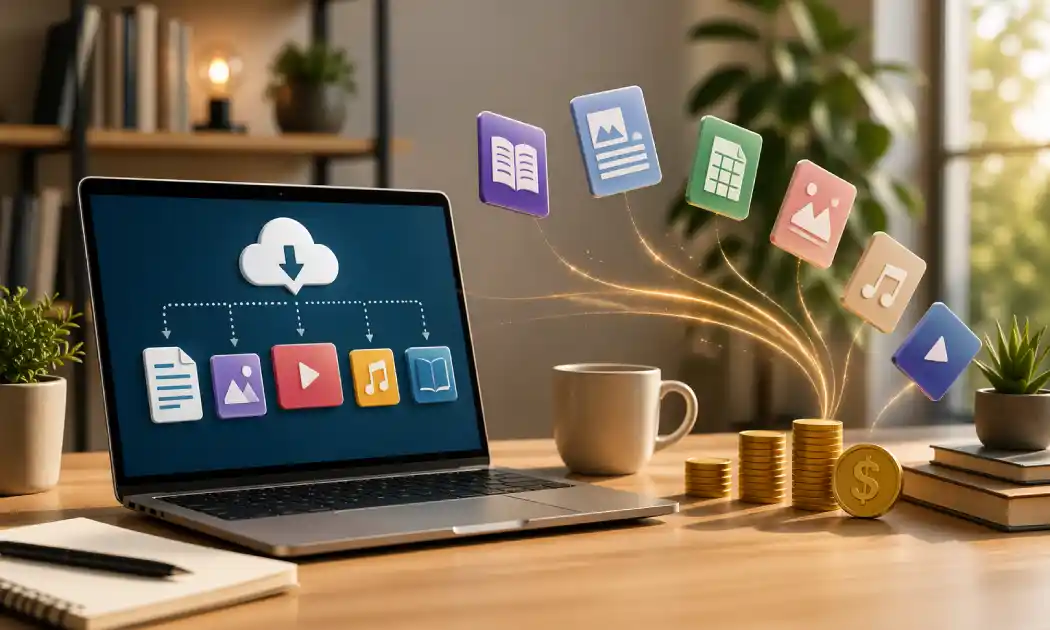
Suggested image file name: how-to-make-passive-income-with-digital-products-funnel.png
Suggested ALT text: digital products passive income funnel showing audience, product, storefront, automation, and repeat revenue
- Automate the post-purchase experience. Shopify can send digital download links automatically, and creator tools like Kit position welcome sequences, nurture campaigns, and product sales flows as 24/7 automations. The practical lesson is simple: your product should not end at checkout. It should lead the buyer into onboarding, proof, and the next offer.
- Add one immediate upsell and one later-stage upsell. A low-ticket template can lead to a bigger toolkit at checkout and then to a course, membership, or newsletter later. This is where “passive” starts to turn into meaningful revenue, because the value of one customer increases over time.
- Collect reviews, screenshots, and success stories early. Proof lowers friction. It also supports E-E-A-T-style trust signals, which Google repeatedly emphasizes in its people-first documentation.
A simple example you can model
- Audience: freelance designers
- Lead magnet: free proposal checklist
- Entry offer: $19 proposal template pack
- Order bump: $29 client onboarding forms
- Core offer: $149 mini-course on building a design client pipeline
- Recurring offer: $15/month resource vault or paid newsletter
That kind of stack is effective because each product logically upgrades the previous one.
Can You Really Make Money Selling Digital Products in …
Optimize for rankings and conversions for passive income
What to do on the page itself
- If you want How to Make Passive Income with Digital Products to rank, make the title and H1 descriptive, concise, and aligned. Google says title links are critical for helping people decide what to click, recommends descriptive and concise <title> text, and notes that title links can be generated from multiple signals if the page title is weak or mismatched.
- Open strong and match search intent fast. Google’s content questions ask whether the main heading gives a helpful summary and whether the page provides a substantial, complete description of the topic. That means your introduction should answer the query early instead of burying the real value under generic filler.
- Use the primary keyword naturally, then let semantic relevance do the heavy lifting. Google explicitly warns against keyword stuffing and also says it does not have a preferred word count. So exact-match usage matters for clarity, but originality, completeness, and usefulness matter more than chasing formulas.
- Write a human meta description, even though Google may rewrite it. Google explains that snippets are primarily created from page content, but it may use the meta description when that text better describes the page. That is why your intro, subheadings, and on-page summary still matter beyond the metadata field.
- Use internal links with meaningful anchor text. Google uses links to discover pages and evaluate relevance, and its link guidance specifically recommends clear anchor text that helps both users and search engines understand what they will see next.
- Treat images like SEO assets, not decorations. Google recommends placing images near relevant text, using short descriptive filenames, writing information-rich alt text in context, and avoiding alt-text keyword stuffing. Google also supports modern formats including WebP and AVIF, and recommends balancing quality with speed.
- Improve real-world page experience. Google recommends good Core Web Vitals and gives concrete thresholds: aim for LCP under 2.5 seconds, INP under 200 ms, and CLS under 0.1. Google also notes that page experience is not the only ranking factor, but a better experience can help when multiple useful pages compete for the same query.
- Use AI as a research assistant, not a replacement for insight. Google says generative AI can help with research and structure, but using automation to produce many pages without adding value can violate spam policies. In practice, use AI for ideation and outlining, then inject real examples, proof, screenshots, and lived expertise before publishing.
Suggested internal and external links
- Internal link: best digital products to sell
- Internal link: email list building for creators
- Internal link: how to write a sales page that converts
- External link: Google image SEO best practices for your image optimization section.
- External link: Search Console performance report for your measurement workflow.
- External link: Control your snippets in search results for your meta description note.
What to measure after publishing
- Track impressions, clicks, CTR, and average position in Search Console so you can see whether the page is being shown, clicked, and matched to the right queries. Google’s Performance report is built for exactly this kind of analysis.
- Check indexing and structured data status with URL Inspection and the Rich Results Test after major edits. Google recommends validating structured data and then monitoring performance over time rather than assuming markup alone will create visibility.
- Refresh substance, not just dates. Google explicitly warns against changing dates or adding content just to appear fresh when the page has not meaningfully improved. Update examples, screenshots, pricing logic, platform recommendations, and FAQs only when you actually have better information.
Conclusion
How to Make Passive Income with Digital Products works best when you stop thinking like a one-off freelancer and start thinking like an asset builder. Choose a specific buyer, solve a specific problem, make delivery automatic, and publish a page that is genuinely useful enough to earn trust, clicks, and repeat visits. That approach aligns with both conversion logic and Google’s people-first content guidance.
If you publish this article on your site, end with a soft CTA that invites readers to share it with a friend, bookmark it, and leave a comment naming the first product they plan to launch. That kind of engagement helps readers feel involved, creates future content ideas, and makes How to Make Passive Income with Digital Products feel achievable rather than theoretical.
FAQs
The Q&A format below is schema-friendly for publishing. If you add FAQPage markup, validate it before launch, but do not expect guaranteed FAQ rich results for a commercial blog. Google currently limits FAQ rich-result eligibility largely to well-known, authoritative government and health sites, so the main benefit for most publishers is cleaner structure and clearer machine understanding.
What is the easiest digital product for beginners?
Templates, checklists, planners, and swipe files are usually the easiest place to start because they are quicker to create, easier to preview, and naturally aligned with instant delivery. Etsy’s own digital-download guidance highlights templates, patterns, and printable-style assets, which tells you exactly where beginner-friendly demand already exists.
Do I need my own website, or can I start on a marketplace?
You can start either way. Marketplaces give you demand and discovery, while your own site gives you more control over brand, data, and upsells. Etsy reported 86.5 million active buyers in 2025, which shows the scale of marketplace demand. Shopify, by contrast, is better when you want an owned storefront with automated digital delivery, while KDP is a solid route for ebook-based offers.
Are digital products really passive?
They are best described as leveraged rather than fully passive. Delivery, checkout, and onboarding can be automated, but product quality, updates, support, positioning, and proof still require human input. That is also consistent with Google’s broader guidance: the pages that keep performing are the ones with real expertise, original value, and an experience that leaves the reader satisfied.
How much should I charge for a digital product?
Price according to the value of the result, not the file size. A short checklist that saves a buyer two hours can be worth more than a 100-page PDF with generic advice. In practice, many creators use a ladder: low-ticket entry product, mid-ticket bundle or mini-course, and recurring membership or newsletter. The stronger your proof and specificity, the easier it is to charge more.
Should I use AI to create digital products or blog content?
Use AI to speed up research, ideation, structure, and drafts, but do not publish thin, generic output and assume it will rank or sell. Google says AI can be useful for research and structuring original work, but scaled pages created without added user value may violate spam policies. Your edge still comes from examples, judgment, screenshots, methodology, and first-hand expertise.
How long does it take to see results?
That depends on your niche, traffic source, offer strength, and proof. Marketplace sales can happen faster because you are borrowing existing demand, while SEO usually compounds over time as Google crawls, understands, and tests the page. Google notes that title changes may take days to weeks to be reflected after recrawling, and Search Console is the right place to monitor impressions, clicks, and CTR while the page matures.