
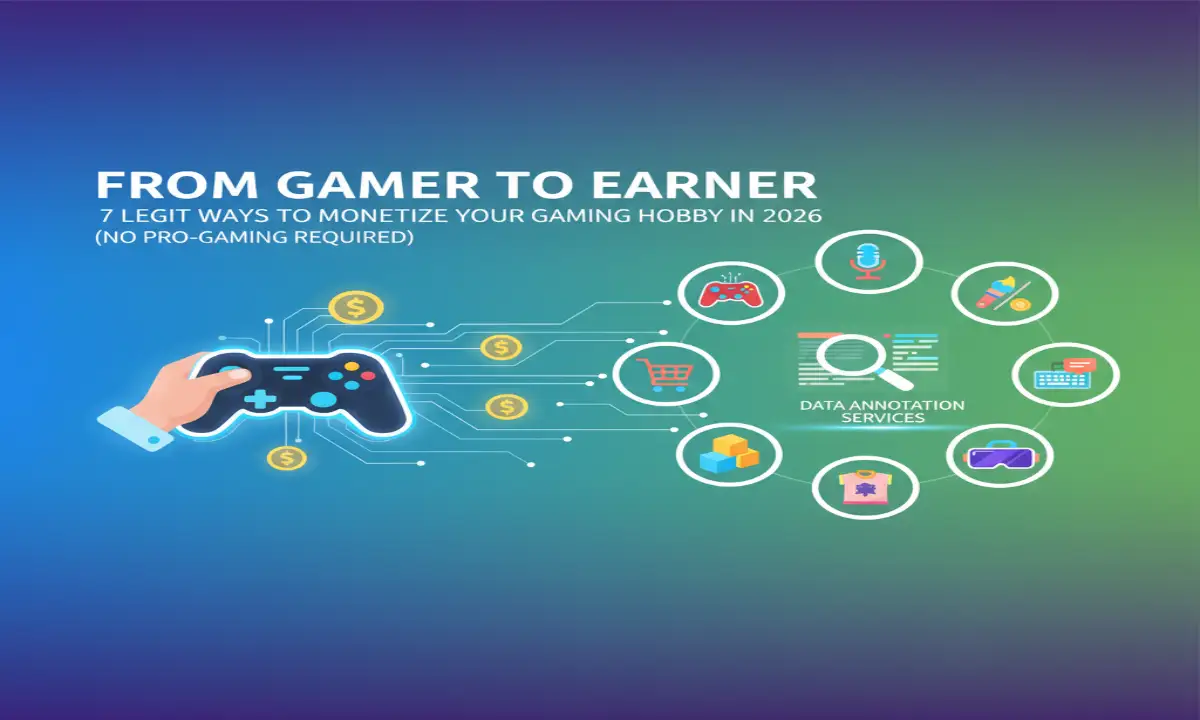

For most of our lives, gaming was just… a thing we did. A pastime. A fun way to blow off steam after a long day? Absolutely. But a real-world skill? Not a chance.
But what if all those hours you poured into mastering recoil patterns, memorizing raid mechanics, and hunting down every last collectible could actually turn into a real, flexible income? Well, it’s 2026. The world has changed. You don’t need to be an sports god to make money from your passion anymore. An entire industry, one supercharged by AI, is practically begging for the exact skills you’ve been building for years without even realizing it.
Consider this your guide to going from gamer to earner by stepping into data annotation services. It’s a legit, entry-level field where your sharp eye and endless patience are way more valuable than your K/D ratio.
It turns out gaming hasn’t just been for fun—it’s been accidental job training. That same hardcore focus you use to spot a sniper glint on a massive map or manage a chaotic RPG inventory is now a hot commodity for building the next wave of AI. We’ll break down seven solid ways you can cash in on these skills, all centered on data annotation and AI training jobs that don’t require you to write a single line of code.
How to Start Freelancing with No Experience in 2026 – A Beginner
The Shifting Landscape of Online Earning: Why Traditional Gigs Aren’t Cutting It Anymore
Remember the gig economy dream? Freedom, flexibility, easy money. Driving for Uber, delivering food, or scrapping for low-paying projects on freelance sites were the main options. By 2026, though, most of those wells have run dry. They’re just too crowded. Earnings have cratered, and the constant hustle feels like a race to the bottom. For most people, making a stable living that way is a joke.
All that burnout has kicked the door wide open for a new kind of work: specialized remote jobs that offer real stability and a future, without needing a four-year degree in programming. The world doesn’t just need more coders; it’s desperate for people who can teach, train, and fine-tune the AI systems those coders build.
This is where data annotation slides in. It’s a stable, booming alternative to the unpredictable gig circus. We’re talking about an AI industry worth hundreds of billions of dollars, and it’s not slowing down anytime soon. Every smart device, self-driving car, and half-decent chatbot runs on mountains of data that was painstakingly labeled by a real person. The demand isn’t just huge—it’s constant. AI always needs fresh data to learn.
What Exactly is Data Annotation, and Why is it Perfect for Gamers?
So before you dive in, let’s get the big question out of the way: What is data annotation? Put simply, it’s labeling stuff so computers can understand what they’re looking at.
Think of it like this. You don’t teach a toddler what a “cat” is by handing them a dictionary. You show them picture after picture of cats, pointing each time and saying, “That’s a cat.”
Data annotation is just the digital, grown-up version of that. The AI is the toddler, and you’re the teacher, labeling images, text, and videos to create a picture book for the machine to study.
Types of Data Annotation
The work itself is pretty diverse, but most of it falls into a few main buckets:
Image & Video Annotation: This means drawing boxes (called bounding boxes) around objects, tracing their exact outlines (polygons), or just classifying a whole scene. This is how you train everything from self-driving cars to AI that helps doctors spot diseases on X-rays.
- Text Annotation: Here, you’re highlighting bits of text to identify things like sentiment (is this reviewer happy or absolutely furious?), named entities (people, places, companies), or what someone is trying to accomplish. This is the magic behind every helpful chatbot and search engine.
- Audio Annotation: This is all about typing out what people say in an audio clip (transcription), identifying who is speaking, or labeling background noises. It’s the behind-the-scenes work that makes Alexa and Siri actually useful.
The Gamer Skill-to-Job Pipeline
Okay, here’s where it all clicks into place. Your gaming hobby? It’s basically a resume in disguise. The skills you’ve been grinding for translate directly.
- Attention to Detail: You know that feeling of scanning every last pixel for a hidden chest or a camouflaged enemy? That’s the exact same skill you need to draw a perfectly tight bounding box around a pedestrian for a self-driving car’s AI.
- Pattern Recognition: Learning a raid boss’s attack patterns to predict the next AoE is the same mental muscle you use to spot recurring themes or weird outliers in a gigantic dataset. It’s second nature to you.
- Focus and Patience: If you’ve ever spent a whole weekend grinding for XP or farming a rare boss drop, you have the mental stamina for large, repetitive annotation projects. It’s the same “zone.” You know how to do it.
- Following Complex Rules: Every game has a rulebook, whether it’s written down or not. Annotation projects come with detailed instructions you have to follow to the letter. Your knack for mastering game mechanics in minutes makes you a natural.
Demystifying AI: You Are the Teacher, Not the Coder
A ton of people hear “AI job” and immediately think you need a Ph.D. in computer science. For this? Not a chance. You don’t have to know Python or understand a single complex algorithm. Your entire job is to supply the high-quality, human-approved data that the algorithms learn from. You’re a critical part of the process, and you can directly earn money training AI without ever touching a line of code.
Getting Started in Data Annotation: Your Entry Point to AI Training Jobs Online
One of the best things about this field is how easy it is to get started. Seriously. Dozens of platforms are looking for reliable people right now and offer data annotation jobs for beginners. You don’t need a fancy degree or a slick corporate resume.
Essential Prerequisites
While the bar is low, you do need a few basics:
- A Reliable Computer and Internet Connection: This is your office. The work is 100% remote. No commuting.
- Strong English Comprehension: Project instructions can be long and crazy specific. You have to be able to read them and know exactly what’s being asked of you.
- Keen Attention to Detail: I’m saying it again because it’s the whole ballgame. Accuracy is everything. Sloppy work means you won’t see the good, high-paying projects.
- Self-Discipline and Time Management: You’re your own boss here. No one’s looking over your shoulder. You have to be able to manage your time and hit deadlines.
Finding Entry-Level Platforms
Several huge companies run platforms that contract thousands of people for this kind of work. Here are some of the best places to get your foot in the door:
- Appen: One of the giants. Appen has a ton of different projects, from rating search results to annotating images. It’s a fantastic place to start just because of the sheer volume of work they have.
- Remotasks: This platform is owned by Scale AI, a major player in the industry. It often focuses on annotation for self-driving cars and other cutting-edge tech. They even offer free online training to teach you complex tasks like LiDAR and video annotation.
- Clickworker: A crowdsourcing platform with a mix of “microtasks.” You’ll find data annotation alongside stuff like writing short texts and taking surveys. It’s a great way to dip your toes in and earn cash in smaller bursts.
- Scale AI: While Remotasks is their main entryway for beginners, Scale AI also hires directly for more complicated, higher-quality annotation gigs. If you build a solid reputation on Remotasks, you can often get access to better-paying projects directly from them.
Creating a Profile That Highlights Your Gamer Skills
When you sign up, they’ll ask about your skills. Don’t just say “I play video games.” You have to translate that experience into professional-speak.
- Instead of: “I’m good at FPS games.”
- Try: “Experienced in tasks requiring rapid visual scanning, object identification, and high levels of accuracy under pressure.”
- Instead of: “I enjoy long RPGs.”
- Try: “Demonstrated ability to maintain focus and follow complex, multi-step instructions over extended periods to achieve long-term objectives.”
See the difference? You’re not making anything up. You’re just framing your skills to show that you get what the job actually entails.
The 7 Ways To Monetize Your Skills
Alright, let’s get to the good stuff. Here are seven real ways you can start earning, kicking off with the bread-and-butter of the industry.
Way 1: Image and Video Annotation – Spotting the Difference Like a Pro Gamer
This is the most common type of annotation, and it’s the one that feels the most like playing a game.
- Object Recognition & Bounding Boxes: You’ll draw simple rectangles around things in photos. Think of it like dragging a selection box over units in an RTS game or tagging an enemy for your squad. You might be labeling cars and people, traffic signs, or even products on a store shelf.
- Semantic Segmentation: This is the expert mode. Instead of a box, you “color in” every single pixel of an object. For instance, every pixel that’s part of a road gets colored blue, and every pixel of a tree gets colored green. It takes incredible precision—kind of like making a custom skin for your character, one pixel at a time.
- Video Annotation: Here, you’re tracking objects as they move through a video, frame by frame. It’s like watching a game replay to analyze a player’s movement, but you’re teaching an AI how a pedestrian crosses the street or how another car might merge into traffic.
Real-world impact: This isn’t just busy work. You’re directly training the AI for self-driving cars (Tesla Autopilot, Waymo), cashier-less Amazon Go stores, and even AI that helps radiologists find tumors on medical scans.
Way 2: Text and Audio Annotation – Understanding the Nuances of Language
If you’re more of a story-driven RPG fan or the one always making callouts in team chat, your skills are a perfect fit for these tasks.
- Sentiment Analysis: You read a chunk of text—a product review, a tweet, a customer service chat—and decide if the tone is positive, negative, or neutral. It’s not that different from gauging your team’s morale by the salt levels in the chatbox.
- Named Entity Recognition (NER): This is a fancy term for finding and highlighting key info in text, like names, companies, locations, and dates. It’s the digital version of scanning a quest log to find the NPC’s name and what town they’re in.
- Transcription and Diarization: This starts simple: turn audio into text. But then comes “diarization,” where you also have to label who is speaking and when. It requires a good ear and some serious focus to keep track.
Real-world impact: This is the secret ingredient that powers assistants like Siri and Alexa, makes customer service chatbots less robotic, and refines the search results you get from Google.
Way 3: Leveraging Your Niche Gaming Knowledge for Specialized Annotation
This is where you can start making seriously good money. Generic annotation is a great entry point, but specialized knowledge is a superpower.
- Game Asset Annotation: Game studios are now using AI to help build their massive open worlds. They need people to label 3D models, classify textures (“cobblestone” vs. “brushed metal”), and tag character animations. If you know the difference between a “greave” and a “gauntlet,” you’re already miles ahead of everyone else.
- Esports Analytics: AI is being developed to coach esports players, and it needs a ton of data. You could get paid to watch pro matches and tag key events—a headshot in Valorant, a clutch Ultimate in Overwatch, or a successful gank in League of Legends.
- Bug Reporting and UX Feedback: Devs need players to annotate screenshots or videos of gameplay to point out bugs, clunky UI, or weird player behavior. This helps them train AI that can automate big chunks of their QA testing process.
Way 4: AI Chatbot Training and Conversation Review
This is a step up from just labeling. Here, you interact directly with the large language models (LLMs) behind tools like ChatGPT. Your job is to act as a human sparring partner to make the AI smarter, safer, and a lot more human. You’ll do things like:
- Rate two different AI-generated answers and explain which one is better and why.
- Rewrite a bad AI response to make it more helpful, factual, and less weird.
- Roleplay as a specific persona (like a confused customer or a curious kid) to test if the AI can adapt its tone.
Gamers are perfect for this. You’re already used to poking and prodding game systems and NPCs just to see how they work and where you can break them.
Way 5: Search Engine Evaluation
Before chatbots were all the rage, this was the original entry-level remote job in the AI world. And it’s still a massive industry. As an evaluator, you’re given a search query (“best pizza near me”) and the webpage Google provides. Your job is to rate how helpful and relevant that page is based on a very strict set of rules. It takes sharp judgment—the same kind you use to map out the optimal skill tree or gear loadout in an RPG.
Way 6: Data Collection
Sometimes, AI companies don’t need you to label data; they need you to go out and create it. Data collection projects pay you to gather the raw materials. This could mean:
- Taking pictures of specific items around your house (e.g., “ten photos of different types of shoes”).
- Recording yourself saying short phrases to train voice recognition models.
- Finding specific examples of information online and popping it all into a spreadsheet.
These are usually quick, one-off tasks that are a great way to supplement your main annotation income.
Way 7: Data Verification and Quality Assurance
After a small army of annotators labels a mountain of data, somebody has to double-check their work. That someone is a data verifier. Your job is to review what other annotators have done and either approve it or fix their mistakes. This role pays better than entry-level work because it requires more skill and a lot more trust. The best way to get promoted into a Quality Assurance (QA) or Reviewer role is to first be a rock-solid, hyper-accurate annotator yourself.
How to Make Money Gaming: 11 Proven Ways (2026)
Maximizing Your Earnings and Career Growth in Data Annotation
When you’re starting, the pay can be modest. You’re often looking at somewhere between $12-$20 USD per hour (~€11-€18 / £9-£15), depending on the platform and project. But this isn’t a dead-end gig. There’s a real path forward if you play your cards right.
Strategies for Higher Pay
- Focus on Accuracy: In the data annotation services world, quality is king. Your accuracy score is your most important stat. Keep it high, and the platforms will start sending the better, higher-paying projects your way.
- Take Qualification Tests: Always be on the lookout for new tests on the platforms. Passing them unlocks new types of work that are usually more complex and—you guessed it—pay better.
- Build Speed (Without Sacrificing Quality): Once your accuracy is consistently top-notch, then you can work on getting faster. For projects that pay per task instead of per hour, your speed directly determines your hourly rate.
- Diversify Your Platforms: Don’t put all your eggs in one basket. Sign up for two or three of the big platforms. That way, if projects dry up on one, another will likely have work waiting for you.
Your Career Path in the AI Industry
Data annotation is a fantastic foot in the door to the tech industry. With a year or two of solid experience, you can start moving up the ladder, even without knowing how to code.
- Data Annotator (Entry-Level): This is where you learn the ropes. You learn the job and build a reputation for being accurate and reliable.
- Quality Reviewer / Team Lead: You graduate to reviewing other people’s work, mentoring new folks, and becoming the go-to person for ensuring project quality.
- Project Manager: With a deep understanding of the whole annotation process, you can move into management—running entire projects, talking to clients, and managing teams of reviewers and annotators.
Is Data Annotation the Right Path for You? Considerations for Stability and Growth
Let’s be clear: this is not a “get rich quick” scheme. It is, however, a legitimate and stable way to earn money training AI. But you should weigh the good with the bad.
Pros:
- Flexibility: Real, actual flexibility. Most platforms let you work whenever you want, from wherever you want.
- Low Barrier to Entry: No degree? No corporate job history? No problem. If you’re detail-oriented and reliable, you can start earning.
- Growing Demand: The AI industry’s hunger for good data is practically infinite. That means real job security for good workers.
- Meaningful Work: It’s actually pretty cool. You’re on the front lines, helping build the tech that is actively shaping our future.
Cons:
- Repetitive Work: Some projects can feel like a grind. But let’s be honest, what gamer hasn’t learned to embrace the grind for a good reward?
- Requires Discipline: You have to be your own boss. If you get distracted easily or need someone looking over your shoulder, this can be a tough gig.
- Variable Pay: Your income can swing up and down based on project availability. This is exactly why signing up for multiple platforms is so important.
For anyone looking for entry-level remote jobs in 2026 and beyond, data annotation is a smart, future-proof play. It’s one of the few fields where human intelligence is still the most vital ingredient for creating artificial intelligence.
Conclusion
The line between “playing” and “working” has officially blurred. That passion for video games has accidentally armed you with a unique—and surprisingly valuable—set of skills that the tech industry is clamoring for. The world of data annotation services is a legitimate, accessible, and booming field that perfectly matches the detail-obsessed mindset you’ve spent thousands of hours honing. It’s a real way to get in on the AI revolution, with a stable income and a clear career path that leaves the old gig economy in the dust. So, stop thinking of your gaming time as “just a hobby.” It’s time to put those skills to work. Check out the platforms we mentioned, reframe your experience, and take that first step from dedicated gamer to a paid expert in the wild world of AI.